
How do you know your use of AI is under control?
A plain-language operating model for companies that use AI, not companies that build it. Four planes, one gate, one loop, one signature. Published open. Running in production on our own systems.
AI doesn't dilute accountability. It concentrates it. Every sanctioned use has a named owner. Every consequential output has a human who adopted it. Every year, an officer signs: the register is complete, the controls operate, exceptions are disclosed.
This is the architecture that has always worked: financial controls after SOX, cyber attestation under DFARS. The signature is what turns policy into behavior.
Within a few years, customers, insurers, and regulators will ask for a signed AI attestation the way they ask for a SOC 2 today. The companies that can produce one on request will have built this model, whether they call it that or not.
One plain question, a small set of artifacts, and a named owner, per plane.
Four planes, four questions, four owners, one signature over the top. Everything else is implementation.
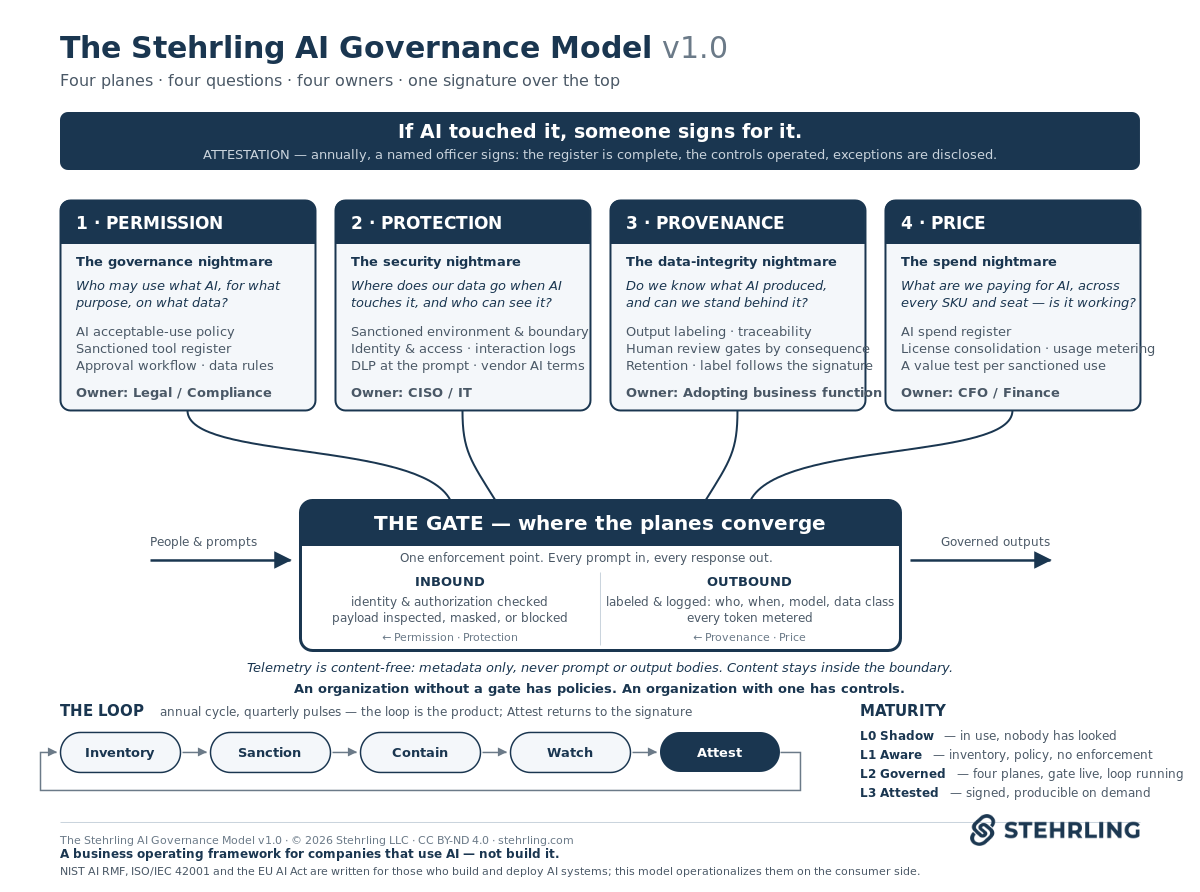
In a governed environment, every prompt passes through a single enforcement point on the way in, and every response passes through it on the way out.
Identity and authorization checked. Payload inspected, blocked, or masked.
Response labeled and logged: who, when, which model, what data class. Every token metered.
An organization without a gate has policies. An organization with one has controls.
Two design rules keep the gate honest and portable. Its telemetry is content-free: metadata only, never prompt or output bodies; content stays inside the governed boundary. And the gate is a specification, not a product: it assembles from the native controls of whatever environment hosts it. No new software is required to be governed.
The model runs as an annual cycle with quarterly pulses, because the AI landscape changes faster than any policy.
Find everything in use, sanctioned and shadow. Decide per tool: approve, contain, or kill. Route sensitive work inside the boundary. Watch usage, spend, and change every quarter. Then a named officer signs. The loop is the product.
| Level | Name | Meaning |
|---|---|---|
| 0 | Shadow | AI is in use; leadership hasn't looked. Most companies today. |
| 1 | Aware | Inventory done, policy exists, nothing enforced. |
| 2 | Governed | Four planes operating, gated environment live, loop running. |
| 3 | Attested | A signed attestation, producible on demand to a customer, insurer, or regulator. |
Could you hand a customer your signed AI attestation tomorrow?
Stehrling operates its own governed AI environment on FedRAMP High-authorized infrastructure in AWS GovCloud, runs the loop on its own AI use, and executed the first signed attestation under this model on August 22, 2026. We built it for defense contractors, where the data class is CUI and the controls have to survive an assessor.
The Stehrling AI Governance Model is a business operating framework for companies that use AI. NIST AI RMF, ISO/IEC 42001 and the EU AI Act are written for those who build and deploy AI systems; this model operationalizes them on the consumer side. It is published under Creative Commons BY-ND 4.0. The canonical version lives on this page.
Attribution: The Stehrling AI Governance Model, © 2026 Stehrling LLC, CC BY-ND 4.0.
Version 1.0 · August 22, 2026 · License terms
Building the gated environment, running the loop, and getting you to an attestation you can hand to anyone who asks. That's what we do.
Talk to Stehrling →
An independent firm building NIST 800-171 compliance programs and AI governance for defense contractors and the DIB.